Dickens & Rumi
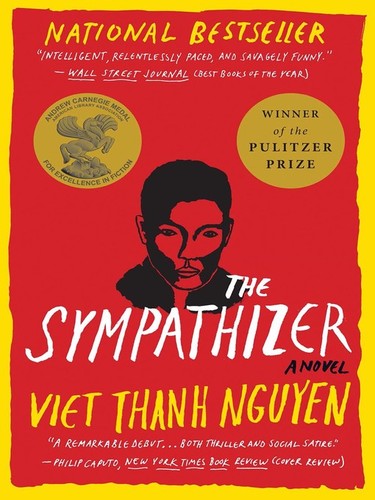
Cover of The Sympathizer

book

The Sympathizer

Age rating, content warnings & parent guide

Viet Thanh Nguyen · 2015

Is The Sympathizer appropriate for your child? See the reviewed age guidance, content cautions, positive themes, and supporting evidence below.

Explore the age guidance, content cautions, positive qualities, and supporting notes for The Sympathizer by Viet Thanh Nguyen. This book is recommended for ages 18+; content notes include Death of a character, Violence, Frightening scenes; positive qualities include Courage & resilience, Creativity & curiosity.

Ages 18+Source checked

Why this age? Adult literary fiction includes repeated wartime violence and death, murder, torture, rape, sexual relationships, psychological trauma, imprisonment, and complex political themes. This is guidance, not a safety guarantee; reading level and family context may differ.

Where to get it

As an Amazon Associate and Bookshop.org affiliate, Dickens & Rumi may earn a small commission from qualifying purchases, at no extra cost to you.

10-second decision

Is this likely to fit your family?

Age guidanceAges 18+
Strongest cautionsDeath of a character 5/5 · Violence 5/5 · Frightening scenes 4/5
Strongest positivesCourage & resilience 4/5 · Creativity & curiosity 4/5
Recommendation4/5

Courage & resilience; strongest caution: death of a character.

This is the quick scan. Open the evidence and methodology below for the basis behind each rating.

Quick context

What parents should know

Adult literary fiction includes repeated wartime violence and death, murder, torture, rape, sexual relationships, psychological trauma, imprisonment, and complex political themes. This is guidance, not a safety guarantee; reading level and family context may differ. Courage & resilience; strongest caution: death of a character.

Readiness snapshotAge guidance: 18+Main watch-out: Death of a character 5/5
Recommendation 4/5

Editorial rating

How this review was built

Dickens & Rumi editorial
Source checkedPublication method
17Scored categories
17Evidence notes
0Explicit 0/5 checks
Oct 22, 2026Last updated

Dickens & Rumi describes what is present; families decide what matters to them. Community reactions are kept separate from official content ratings.

Review depth17 scored categories17 evidence notes
Show Wikipedia summary

Open to load a short Wikipedia summary.

Quick view

At a glance

Recommended age18+

Strongest cautions

  • Death of a character5/5
  • Violence5/5
  • Frightening scenes4/5

Strongest positives

  • Courage & resilience4/5
  • Creativity & curiosity4/5
  • Diverse representation4/5

Keep going

What should you do next?

One review should lead naturally to the next useful choice.

Similar, with lighter cautions

Want something gentler?

These reviewed titles have overlapping age guidance and a lower total caution score than The Sympathizer. Open each review for the details.

What’s in it?

Products & advertising1/5
Why this rating?

A liquor store and American commercial culture appear in the story, without evidence of promotional product placement or purchasing pressure.
Death of a character5/5
Why this rating?

Multiple deaths are central, including the narrator's friend's wife and child, a framed officer, a newspaper editor, and wartime victims.

Graphic injury4/5
Why this rating?

Contains visceral depictions of injuries, deaths, and the lasting physical effects of napalm burns.

Strong language4/5
Why this rating?

The novel uses frequent strong profanity and harsh, politically and culturally charged language, though the supplied excerpt provides only limited direct examples.

Religious themes2/5
Why this rating?

The narrator's French Catholic priest father is part of his background, but religious practice is not a central focus in the summary.

Romance3/5
Why this rating?

The narrator has affairs and sexual relationships, but romance is secondary to espionage, war, identity, and political conflict.

Frightening scenes4/5
Why this rating?

The novel presents sustained wartime danger, executions, explosions, capture, imprisonment, torture, and traumatic political persecution.

Sexual content & nudity4/5
Why this rating?

Adult affairs and sexual relationships occur, alongside the confession's reference to the torturing and raping of a female agent.

Alcohol or drugs3/5
Why this rating?

Alcohol appears in the context of the General's liquor-store business, but substance use is not identified as a central theme.

Violence5/5
Why this rating?

War, military operations, killings, assassination, torture, violent imprisonment, and combat-related danger are central to the plot.

What’s good in it?

Courage & resilience4/5
Why this rating?

Characters face war, exile, imprisonment, and ideological danger; bravery is present but often entangled with risky or morally troubling actions.

Creativity & curiosity4/5
Why this rating?

The novel uses a coerced confession, divided identity, dark comedy, metafiction, and a critique of war cinema to encourage complex interpretation.

Diverse representation4/5
Why this rating?

Vietnamese, Vietnamese-French, Japanese-American, American, and expatriate perspectives are important to the novel's exploration of identity and power.

Educational value4/5
Why this rating?

Its historical fiction explores the Vietnam War, Vietnamese exile, revolutionary politics, cultural representation, and competing perspectives on history.

Kindness & empathy2/5
Why this rating?

Friendship, loyalty, and concern for others appear, but they are repeatedly overwhelmed by war, betrayal, coercion, and political violence.

Positive messages4/5
Why this rating?

The novel strongly examines ideological violence, colonial and cultural power, divided loyalties, dehumanization, and the costs of revolution.

Good role models2/5
Why this rating?

Characters show loyalty and reflection but also espionage, murder, deception, and ideological compromise; the novel is morally complex rather than exemplary.

Family discussion

Talk about it

Conversation starters based on this title’s published content notes.

  1. What did courage look like in this story? Was being brave always the same as being fearless?
  2. How did the story approach death or loss? What helped the characters cope?
  3. Which choice in The Sympathizer would you have made differently, and why?
  4. Who changed the most in The Sympathizer, and what caused that change?
Discuss this title with other parents

Community perspective — separate from editorial ratings

What families noticed

Community signal

Community ratings and written reactions are a separate layer. They do not automatically change Dickens & Rumi’s official age guidance or content scores.

Add your perspective

Sign in from the homepage to rate this title.

If you liked this

Try something nearby

Related by age fit, format, and catalogue context.

These content notes are a starting point, not a guarantee. Review the evidence and use your own judgment before choosing a title.

Something wrong with this guide? Report age, caution, series, cover, or title issues.