Dickens & Rumi
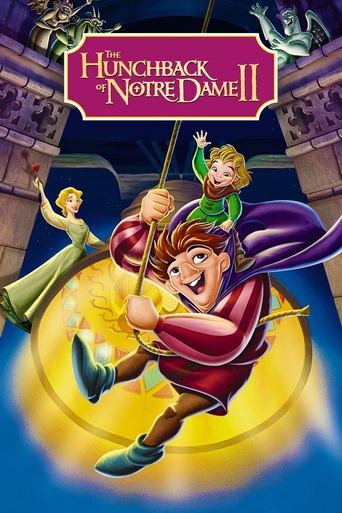
Cover of The Hunchback of Notre Dame II

film

The Hunchback of Notre Dame II

Age rating, content warnings & parent guide

2002

Is The Hunchback of Notre Dame II appropriate for your child? See the reviewed age guidance, content cautions, positive themes, and supporting evidence below.

Now that Frollo is gone, Quasimodo rings the bell with the help of his new friend and Esmeralda and Phoebus' little son, Zephyr. But when Quasi stops by a traveling circus owned by evil magician Sarousch, he falls for Madellaine, Sarouch's assistant.

Source checked

Where to watch or buy

As an Amazon Associate, Dickens & Rumi may earn from qualifying purchases, at no extra cost to you.

10-second decision

Is this likely to fit your family?

Age guidanceNot listed
Strongest cautionsRomance 3/5 · Frightening scenes 2/5 · Religious themes 2/5
Strongest positivesCourage & resilience 3/5 · Creativity & curiosity 3/5
Recommendation3/5

Courage & resilience; strongest caution: romance.

This is the quick scan. Open the evidence and methodology below for the basis behind each rating.

Quick context

What parents should know

Courage & resilience; strongest caution: romance.

Readiness snapshotMain watch-out: Romance 3/5
Recommendation 3/5

Editorial rating

How this review was built

Dickens & Rumi editorial
Source checkedPublication method
13Scored categories
13Evidence notes
0Explicit 0/5 checks
Oct 24, 2026Last updated

Dickens & Rumi describes what is present; families decide what matters to them. Community reactions are kept separate from official content ratings.

Review depth13 scored categories13 evidence notes

Quick view

At a glance

Recommended ageNot listed

Strongest cautions

  • Romance3/5
  • Frightening scenes2/5
  • Religious themes2/5

Strongest positives

  • Courage & resilience3/5
  • Creativity & curiosity3/5
  • Good role models3/5

Keep going

What should you do next?

One review should lead naturally to the next useful choice.

What’s in it?

Products & advertising1/5
Why this rating?

The circus and its performances are part of the story, but the supplied material does not indicate strong product placement or buying pressure.
Death of a character1/5
Why this rating?

A villain threatens to kill Quasimodo, but the plot describes no death; the threat supports suspense rather than grief.

Religious themes2/5
Why this rating?

Notre-Dame, bells, an archdeacon, and a cathedral setting are prominent, though religious practice is not the central message.

Romance3/5
Why this rating?

Quasimodo and Madellaine's attraction and developing relationship are a major storyline, ending with a first kiss.

Frightening scenes2/5
Why this rating?

Threats, a storm, catacombs, criminal villains, and a child held hostage create moderate but non-graphic suspense.

Violence2/5
Why this rating?

Cartoon adventure includes attempted theft, pursuit, trapping characters, a hostage situation, and rescue peril, without graphic fighting.

What’s good in it?

Courage & resilience3/5
Why this rating?

Characters confront criminals, danger, prejudice, and fear; Madellaine uses her high-wire skills to rescue Zephyr.

Creativity & curiosity3/5
Why this rating?

Circus performance, magic, bell-ringing, imaginative settings, and inventive rescue methods encourage playful imagination and problem-solving.

Diverse representation2/5
Why this rating?

The story centers a visibly different protagonist and includes an orphan seeking belonging, though broader human representation is limited in the supplied material.

Educational value1/5
Why this rating?

The medieval Paris and Notre-Dame setting may offer incidental cultural context, but teaching real knowledge is not the film's main purpose.

Kindness & empathy3/5
Why this rating?

Friendship, acceptance, forgiveness, and care for children are important, especially in Quasimodo's relationships with Zephyr and Madellaine.

Positive messages3/5
Why this rating?

The story supports trust, resisting manipulation, rejecting prejudice, taking responsibility, and giving people opportunities to change.

Good role models3/5
Why this rating?

Quasimodo, Madellaine, and the supporting family show loyalty, empathy, bravery, and accountability, although some characters initially deceive others.

Family discussion

Talk about it

Conversation starters based on this title’s published content notes.

  1. What did courage look like in this story? Was being brave always the same as being fearless?
  2. How did relationships or romance affect the characters’ choices?
  3. Which choice in The Hunchback of Notre Dame II would you have made differently, and why?
  4. Who changed the most in The Hunchback of Notre Dame II, and what caused that change?
Discuss this title with other parents

Community perspective — separate from editorial ratings

What families noticed

Community signal

Community ratings and written reactions are a separate layer. They do not automatically change Dickens & Rumi’s official age guidance or content scores.

Add your perspective

Sign in from the homepage to rate this title.

These content notes are a starting point, not a guarantee. Review the evidence and use your own judgment before choosing a title.

Something wrong with this guide? Report age, caution, series, cover, or title issues.