Dickens & Rumi
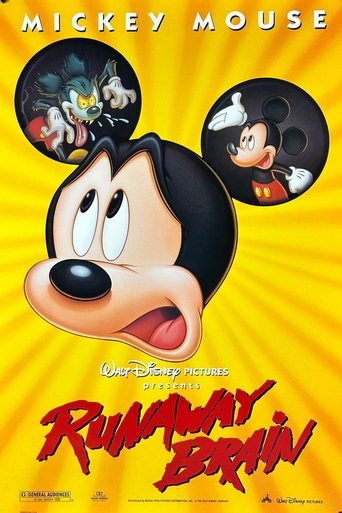
Cover of Runaway Brain

film

Runaway Brain

Age rating, content warnings & parent guide

1995

Is Runaway Brain appropriate for your child? See the reviewed age guidance, content cautions, positive themes, and supporting evidence below.

In an attempt to convince Minnie that he hasn't forgotten to buy her an anniversary present, Mickey Mouse ends up promising to take her to Hawaii. Funds being short, he applies for a job as lab assistant to the sinister Dr. Frankenollie, who happens to be searching for a donor to provide his monstrous creation with a brain.

Source checked

Where to watch or buy

As an Amazon Associate, Dickens & Rumi may earn from qualifying purchases, at no extra cost to you.

10-second decision

Is this likely to fit your family?

Age guidanceNot listed
Strongest cautionsFrightening scenes 4/5 · Violence 3/5 · Death of a character 2/5
Strongest positivesCourage & resilience 3/5 · Creativity & curiosity 3/5
Recommendation2.5/5

Courage & resilience; strongest caution: frightening scenes.

This is the quick scan. Open the evidence and methodology below for the basis behind each rating.

Quick context

What parents should know

Courage & resilience; strongest caution: frightening scenes.

Readiness snapshotMain watch-out: Frightening scenes 4/5
Recommendation 2.5/5

Editorial rating

How this review was built

Dickens & Rumi editorial
Source checkedPublication method
11Scored categories
11Evidence notes
1Explicit 0/5 checks
Oct 23, 2026Last updated

Dickens & Rumi describes what is present; families decide what matters to them. Community reactions are kept separate from official content ratings.

Review depth11 scored categories11 evidence notes

Quick view

At a glance

Recommended ageNot listed

Strongest cautions

  • Frightening scenes4/5
  • Violence3/5
  • Death of a character2/5

Strongest positives

  • Courage & resilience3/5
  • Creativity & curiosity3/5
  • Good role models2/5

Keep going

What should you do next?

One review should lead naturally to the next useful choice.

What’s in it?

Products & advertising1/5
Why this rating?

The plot uses advertisements for a Hawaii trip and a job, with a gift and shopping providing story context; it is not primarily a commercial message.
Death of a character2/5
Why this rating?

The experiment causes Doctor Frankenollie's death, though the available description does not indicate graphic depiction or sustained grief.

Romance2/5
Why this rating?

Mickey and Minnie are an established couple celebrating an anniversary; affection and Mickey's efforts to give her a gift frame the story.

Frightening scenes4/5
Why this rating?

A dark storm, sinister mad scientist, monstrous creation, body/brain transformation, pursuit, and danger high above a city create strong cartoon-horror tension.

Violence3/5
Why this rating?

Mickey and the monster fight, pursue one another, and battle around a skyscraper; the action is exaggerated cartoon violence with limited lasting harm.

Checked and not flagged

No concern recorded in these categories

These categories were explicitly scored 0/5 in the published review. This is not a guarantee that every edition or reader experience is identical.

Graphic injury · 0/5

What’s good in it?

Courage & resilience3/5
Why this rating?

Mickey confronts the monster and returns to danger to rescue Minnie, showing bravery despite fear and physical peril.

Creativity & curiosity3/5
Why this rating?

Inventive fantasy elements include brain-switching, a monster resembling Pete, elaborate escapes, and imaginative cartoon problem-solving.

Kindness & empathy2/5
Why this rating?

Mickey tries to make Minnie happy and later protects her, although the plot is driven more by comic danger and escape than sustained caregiving.

Positive messages2/5
Why this rating?

The story supports loyalty, helping a loved one, resourcefulness, and protecting others, while Mickey's initial deception and risky choices create trouble.

Good role models2/5
Why this rating?

Mickey shows determination and loyalty, but he lies about the gift and enters a dangerous job; his choices are mixed rather than exemplary.

Family discussion

Talk about it

Conversation starters based on this title’s published content notes.

  1. What did courage look like in this story? Was being brave always the same as being fearless?
  2. Which moment felt most tense or frightening? What helped the characters handle fear?
  3. Which choice in Runaway Brain would you have made differently, and why?
  4. Who changed the most in Runaway Brain, and what caused that change?
Discuss this title with other parents

Community perspective — separate from editorial ratings

What families noticed

Community signal

Community ratings and written reactions are a separate layer. They do not automatically change Dickens & Rumi’s official age guidance or content scores.

Add your perspective

Sign in from the homepage to rate this title.

These content notes are a starting point, not a guarantee. Review the evidence and use your own judgment before choosing a title.

Something wrong with this guide? Report age, caution, series, cover, or title issues.