Dickens & Rumi
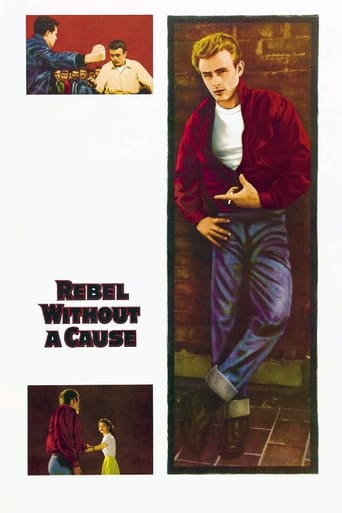
Cover of Rebel Without a Cause

film

Rebel Without a Cause

Age rating, content warnings & parent guide

1955

Is Rebel Without a Cause appropriate for your child? See the reviewed age guidance, content cautions, positive themes, and supporting evidence below.

After moving to a new town, troublemaking teen Jim Stark is supposed to have a clean slate, although being the new kid in town brings its own problems. While searching for some stability, Stark forms a bond with a disturbed classmate, Plato, and falls for local girl Judy. However, Judy is the girlfriend of neighborhood tough, Buzz. When Buzz violently confronts Jim and challenges him to a drag race, the new kid's real troubles begin.

Source checked

Where to watch or buy

As an Amazon Associate, Dickens & Rumi may earn from qualifying purchases, at no extra cost to you.

10-second decision

Is this likely to fit your family?

Age guidanceNot listed
Strongest cautionsDeath of a character 4/5 · Frightening scenes 4/5 · Violence 4/5
Strongest positivesCourage & resilience 3/5 · Kindness & empathy 3/5
Recommendation2.8/5

Courage & resilience; strongest caution: death of a character.

This is the quick scan. Open the evidence and methodology below for the basis behind each rating.

Quick context

What parents should know

Courage & resilience; strongest caution: death of a character.

Readiness snapshotMain watch-out: Death of a character 4/5
Recommendation 2.8/5

Editorial rating

How this review was built

Dickens & Rumi editorial
Source checkedPublication method
16Scored categories
16Evidence notes
0Explicit 0/5 checks
Oct 24, 2026Last updated

Dickens & Rumi describes what is present; families decide what matters to them. Community reactions are kept separate from official content ratings.

Review depth16 scored categories16 evidence notes

Quick view

At a glance

Recommended ageNot listed

Strongest cautions

  • Death of a character4/5
  • Frightening scenes4/5
  • Violence4/5

Strongest positives

  • Courage & resilience3/5
  • Kindness & empathy3/5
  • Positive messages3/5

Keep going

What should you do next?

One review should lead naturally to the next useful choice.

What’s in it?

Death of a character4/5
Why this rating?

A character dies in a car crash, and another is killed by police in a central, emotionally heavy scene.

Graphic injury1/5
Why this rating?

Mention of puppies being killed and a gunshot wound are present, but the film is not graphically violent.

Strong language2/5
Why this rating?

Insults and harsh name-calling occur, including a parent calling Judy a derogatory term; strong profanity is not indicated.

LGBTQIA characters2/5
Why this rating?

Plato is often read as having an implied crush on Jim. This is subtext rather than an explicit LGBTQIA relationship, but it meaningfully shapes his character and story.

Romance3/5
Why this rating?

Jim and Judy's attraction and developing love are a major subplot, including a first kiss.

Frightening scenes4/5
Why this rating?

Realistic car-racing danger, gang pursuit, firearms, a barricade, and a tense police standoff—including a teen's death—make this strongly frightening.

Sexual content & nudity2/5
Why this rating?

Contains mild references to 'racy' clothing and romantic tension, typical of 1950s melodrama.

Alcohol or drugs2/5
Why this rating?

Jim is arrested for public intoxication, but substance use is not described as a sustained or glamorized focus.

Violence4/5
Why this rating?

A knife fight, gang intimidation, a shooting, assault, and a police shooting are central to the escalating conflict.

What’s good in it?

Courage & resilience3/5
Why this rating?

Jim confronts danger, considers confessing, protects Plato, and tries to resolve the armed standoff, although some bravery is mixed with recklessness.

Creativity & curiosity2/5
Why this rating?

The teens use imaginative role-play and problem-solving, especially in the mansion and Jim's attempt to disarm and calm Plato.

Diverse representation1/5
Why this rating?

Focuses on suburban white middle-class experience; representation is limited by the 1950s setting.

Educational value1/5
Why this rating?

It offers social commentary on adolescence, family dynamics, authority, and generational conflict, but is not instructional.

Kindness & empathy3/5
Why this rating?

Jim befriends and protects Plato, Judy apologizes and reconnects, and Frank comforts Jim, though bullying and abandonment are also prominent.

Positive messages3/5
Why this rating?

The film critiques peer pressure, parental failure, emotional isolation, and reckless bravado while valuing honesty, responsibility, and reconciliation.

Good role models2/5
Why this rating?

Jim shows loyalty, honesty, and courage but also fights and behaves recklessly; adults are flawed, though Frank ultimately offers support.

Family discussion

Talk about it

Conversation starters based on this title’s published content notes.

  1. What did courage look like in this story? Was being brave always the same as being fearless?
  2. How did the story approach death or loss? What helped the characters cope?
  3. Which choice in Rebel Without a Cause would you have made differently, and why?
  4. Who changed the most in Rebel Without a Cause, and what caused that change?
Discuss this title with other parents

Community perspective — separate from editorial ratings

What families noticed

Community signal

Community ratings and written reactions are a separate layer. They do not automatically change Dickens & Rumi’s official age guidance or content scores.

Add your perspective

Sign in from the homepage to rate this title.

These content notes are a starting point, not a guarantee. Review the evidence and use your own judgment before choosing a title.

Something wrong with this guide? Report age, caution, series, cover, or title issues.