Dickens & Rumi
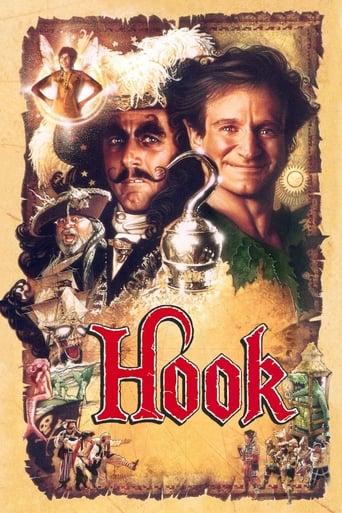
Cover of Hook

film

Hook

1991

The boy who wasn't supposed to grow up—Peter Pan—does just that, becoming a soulless corporate lawyer whose workaholism could cost him his wife and kids. During his trip to see Granny Wendy in London, the vengeful Capt. Hook kidnaps Peter's kids and forces Peter to return to Neverland.

Ages 8+Source checked

Why this age? Fantasy peril includes kidnapping, threatened execution, sword fights, a fatal stabbing, and Hook being consumed by a crocodile. The emotional themes of parental neglect, grief, and reconciliation suit older children. This is guidance, not a safety guarantee; reading level and family context may differ.

Quick view

At a glance

Recommended age8+

Strongest cautions

  • Death of a character3/5
  • Frightening scenes3/5
  • Violence3/5

Strongest positives

  • Courage & resilience4/5
  • Creativity & curiosity4/5
  • Positive messages4/5

What’s in it?

Products & advertising1/5
Why this rating?

Typical of a major studio release; minor merchandising existed at the time of release.

Death of a character3/5
Why this rating?

Rufio dies after being wounded in a duel, and the death carries emotional weight. Hook is also consumed by the crocodile.

Graphic injury1/5
Why this rating?

There is fantasy violence resulting in a death, but it is not graphic or overly bloody.

Strong language1/5
Why this rating?

Occasional mild name-calling and insults common in fantasy adventure films.

Romance1/5
Why this rating?

Adult family love is central; Tinker Bell confesses unrequited love, and Peter's past includes romantic feelings for Moira.

Frightening scenes3/5
Why this rating?

Children are kidnapped and threatened by pirates; Hook, the crocodile, combat, and danger in Neverland may frighten younger viewers.

Violence3/5
Why this rating?

Repeated fantasy action includes swordplay, pirate attacks, threatened execution, combat, and a fatal duel, though it is stylized rather than realistic.

What’s good in it?

Courage & resilience4/5
Why this rating?

Peter and the children face kidnapping, fear, and combat; courage is linked to love, responsibility, imagination, and protecting others.

Creativity & curiosity4/5
Why this rating?

Imagination, flying, play, inventive training, fantasy worlds, and creative problem-solving are central to Peter's transformation.

Diverse representation2/5
Why this rating?

The Lost Boys are depicted as a diverse group, though the core cast is largely traditional for the era.

Educational value1/5
Why this rating?

It offers limited incidental lessons about family, responsibility, memory, and emotional growth rather than formal education.

Kindness & empathy3/5
Why this rating?

Care, loyalty, reconciliation, and helping others are important, especially among Peter, his children, Tinker Bell, and the Lost Boys.

Positive messages4/5
Why this rating?

The story strongly emphasizes presence in family life, keeping promises, imagination, courage, forgiveness, and embracing meaningful relationships.

Good role models3/5
Why this rating?

Peter begins as neglectful and work-obsessed but changes substantially; the Lost Boys show loyalty and courage, while Hook is a harmful model.

Family discussion

Talk about it

Conversation starters based on this title’s published content notes.

  1. What did courage look like in this story? Was being brave always the same as being fearless?
  2. How did the story approach death or loss? What helped the characters cope?
  3. Which choice in Hook would you have made differently, and why?
  4. Who changed the most in Hook, and what caused that change?
Discuss this title with other parents

Community reactions

What families noticed

Add your perspective

Sign in from the homepage to rate this title.

Where to watch or buy

As an Amazon Associate, Dickens & Rumi may earn from qualifying purchases, at no extra cost to you.

These content notes are a starting point, not a guarantee. Review the evidence and use your own judgment before choosing a title.

Report an incorrect rating