Dickens & Rumi
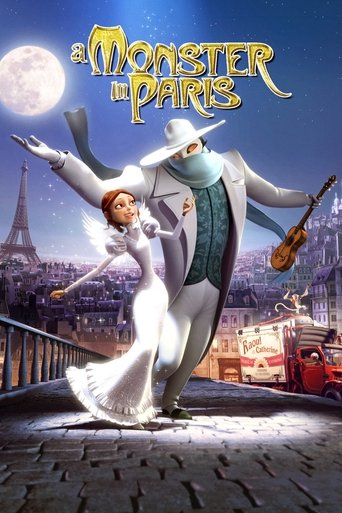
Cover of A Monster in Paris

film

A Monster in Paris

Age rating, content warnings & parent guide

2011

Is A Monster in Paris appropriate for your child? See the reviewed age guidance, content cautions, positive themes, and supporting evidence below.

Paris, 1910. Emile, a shy movie projectionist, and Raoul, a colourful inventor, find themselves embarked on the hunt for a monster terrorizing citizens. They join forces with Lucille, the big-hearted star of the Bird of Paradise cabaret, an eccentric scientist and his irascible monkey to save the monster, who turns out to be an oversized but harmless flea, from the city's ruthlessly ambitious police chief.

Source checked

Where to watch or buy

As an Amazon Associate, Dickens & Rumi may earn from qualifying purchases, at no extra cost to you.

10-second decision

Is this likely to fit your family?

Age guidanceNot listed
Strongest cautionsFrightening scenes 3/5 · Death of a character 2/5 · Romance 2/5
Strongest positivesCreativity & curiosity 4/5 · Kindness & empathy 4/5
Recommendation3.8/5

Creativity & curiosity; strongest caution: frightening scenes.

This is the quick scan. Open the evidence and methodology below for the basis behind each rating.

Quick context

What parents should know

Creativity & curiosity; strongest caution: frightening scenes.

Readiness snapshotMain watch-out: Frightening scenes 3/5
Recommendation 3.8/5

Editorial rating

How this review was built

Dickens & Rumi editorial
Source checkedPublication method
14Scored categories
14Evidence notes
0Explicit 0/5 checks
Oct 23, 2026Last updated

Dickens & Rumi describes what is present; families decide what matters to them. Community reactions are kept separate from official content ratings.

Review depth14 scored categories14 evidence notes

Quick view

At a glance

Recommended ageNot listed

Strongest cautions

  • Frightening scenes3/5
  • Death of a character2/5
  • Romance2/5

Strongest positives

  • Creativity & curiosity4/5
  • Kindness & empathy4/5
  • Positive messages4/5

Keep going

What should you do next?

One review should lead naturally to the next useful choice.

What’s in it?

Death of a character2/5
Why this rating?

Francœur is believed to have been killed after a gunshot and disappearance, but he is later revealed to be alive.

Strong language1/5
Why this rating?

Language appears mild, with occasional insults or negative descriptors rather than strong profanity or slurs.

Romance2/5
Why this rating?

There are love interests, marriage pressure, a romantic subplot and a couple forming, but romance is not the main focus.

Frightening scenes3/5
Why this rating?

A giant creature terrifies residents, is hunted by authorities, and faces tense chases and danger at the Eiffel Tower.

Sexual content & nudity1/5
Why this rating?

Some mild cabaret-style costumes and flirtatious dialogue typical of the era depicted.

Alcohol or drugs1/5
Why this rating?

Brief background depictions of cabaret life might include social settings, but no focus on substance use.

Violence2/5
Why this rating?

Monster hunts, pursuits, confrontations and a battle occur, including a gunshot; violence is fantastical and not portrayed as gory.

What’s good in it?

Courage & resilience3/5
Why this rating?

Characters face public fear, pursuit and physical danger to protect Francœur and oppose an unjust hunt.

Creativity & curiosity4/5
Why this rating?

Inventive potions, music, theatrical disguises and imaginative problem-solving drive the adventure and encourage playful fantasy.

Diverse representation2/5
Why this rating?

Includes a variety of character archetypes, though primarily focused on local Parisian representation.

Educational value1/5
Why this rating?

Introduces elements of historical Paris and artistic culture, albeit in a fantastical setting.

Kindness & empathy4/5
Why this rating?

Lucille shelters and protects Francœur, while the friends cooperate to save him from persecution and help correct misunderstandings.

Positive messages4/5
Why this rating?

The story strongly supports empathy toward outsiders, resisting prejudice, friendship, cooperation and judging individuals by their actions rather than appearance.

Good role models3/5
Why this rating?

Lucille and her friends protect a harmless outsider and show loyalty and ingenuity, though some characters act irresponsibly or selfishly.

Family discussion

Talk about it

Conversation starters based on this title’s published content notes.

  1. What was the most imaginative idea in the story, and what would you add to it?
  2. Which moment felt most tense or frightening? What helped the characters handle fear?
  3. Which choice in A Monster in Paris would you have made differently, and why?
  4. Who changed the most in A Monster in Paris, and what caused that change?
Discuss this title with other parents

Community perspective — separate from editorial ratings

What families noticed

Community signal

Community ratings and written reactions are a separate layer. They do not automatically change Dickens & Rumi’s official age guidance or content scores.

Add your perspective

Sign in from the homepage to rate this title.

These content notes are a starting point, not a guarantee. Review the evidence and use your own judgment before choosing a title.

Something wrong with this guide? Report age, caution, series, cover, or title issues.