Dickens & Rumi
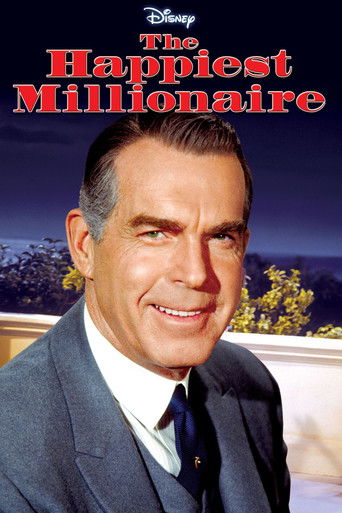
Cover of The Happiest Millionaire

film

The Happiest Millionaire

1967

A happy and unbelievably lucky young Irish immigrant, John Lawless, lands a job as the butler of an unconventional millionaire, Biddle. His daughter, Cordelia Drexel Biddle, tires of the unusual antics of her father--especially since the nice young men around town all fear him. Wouldn't you fear a father-in-law that keeps alligators for pets and teaches boxing at his daily Bible classes?

Ages 7+Source checked

Why this age? G-rated family entertainment with mild comic fighting, a bar fight, jail, relationship conflict, and historical wartime context. Younger children may need help with the lengthy plot and old-fashioned social attitudes. This is guidance, not a safety guarantee; reading level and family context may differ.

Quick view

At a glance

Recommended age7+

Strongest cautions

  • Romance3/5
  • Frightening scenes2/5
  • Religious themes2/5

Strongest positives

  • Creativity & curiosity3/5
  • Good role models3/5
  • Kindness & empathy3/5

Keep going

What should you do next?

One review should lead naturally to the next useful choice.

What’s in it?

Strong language1/5
Why this rating?

Contains very mild, period-appropriate frustration.

Religious themes2/5
Why this rating?

Biddle runs a Bible school, making Christianity a noticeable setting and theme, though not described as doctrinally intense.

Romance3/5
Why this rating?

Cordy and Angier fall in love, become engaged, break up, and elope; romance is a major story thread.

Frightening scenes2/5
Why this rating?

A character keeps alligators in a conservatory, which may be slightly surprising but is not presented in a scary way.

Sexual content & nudity1/5
Why this rating?

No sexual content or nudity.

Alcohol or drugs1/5
Why this rating?

Characters are seen in a tavern environment, typical of the era, but there is no glorification of alcohol use.

Violence2/5
Why this rating?

Boxing and jiu-jitsu are recurring comic elements; a bar fight leads to arrest, but severe harm is not indicated.

What’s good in it?

Courage & resilience2/5
Why this rating?

Characters confront family expectations, social conventions, and difficult choices; some physical behavior is impulsive rather than exemplary.

Creativity & curiosity3/5
Why this rating?

Celebrates unconventional thinking and finding one's own path.

Diverse representation1/5
Why this rating?

Portrays class dynamics of the period; diversity is limited by historical setting.

Educational value1/5
Why this rating?

The period setting offers incidental context about 1916–1917 society, family wealth, gender expectations, and business.

Kindness & empathy3/5
Why this rating?

Characters demonstrate loyalty and support for one another.

Positive messages3/5
Why this rating?

Encourages following one's dreams and emphasizes the value of family and integrity.

Good role models3/5
Why this rating?

Characters are generally positive, though the father's eccentricities are a major focus.

Family discussion

Talk about it

Conversation starters based on this title’s published content notes.

  1. What was the most imaginative idea in the story, and what would you add to it?
  2. How did relationships or romance affect the characters’ choices?
  3. Which choice in The Happiest Millionaire would you have made differently, and why?
  4. Who changed the most in The Happiest Millionaire, and what caused that change?
Discuss this title with other parents

Community reactions

What families noticed

Add your perspective

Sign in from the homepage to rate this title.

Where to watch or buy

As an Amazon Associate, Dickens & Rumi may earn from qualifying purchases, at no extra cost to you.

These content notes are a starting point, not a guarantee. Review the evidence and use your own judgment before choosing a title.

Something wrong with this guide? Report age, caution, series, cover, or title issues.