Dickens & Rumi
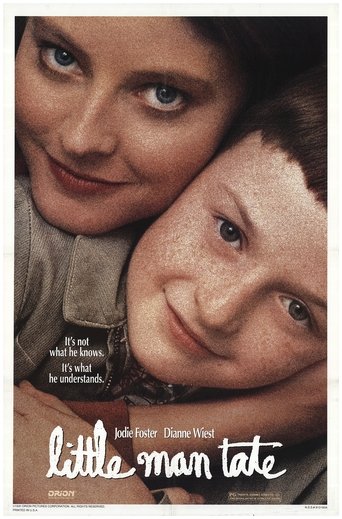
Cover of Little Man Tate

film

Little Man Tate

1991

Dede is a sole parent trying to bring up her son Fred. When it is discovered that Fred is a genius, she is determined to ensure that Fred has all the opportunities that he needs, and that he is not taken advantage of by people who forget that his extremely powerful intellect is harboured in the body and emotions of a child.

Ages 10+Source checked

Why this age? The film is generally gentle but includes a child’s emotional breakdown, nightmares, social isolation, adult relationship context, and pressure from public exposure. Its themes may be most meaningful for older children. This is guidance, not a safety guarantee; reading level and family context may differ.

Quick view

At a glance

Recommended age10+

Strongest cautions

  • Frightening scenes2/5
  • Alcohol or drugs1/5
  • Death of a character1/5
Strongest positives

  • Kindness & empathy4/5
  • Positive messages4/5
  • Courage & resilience3/5

What’s in it?

Death of a character1/5
Why this rating?

No actual death occurs; Fred briefly claims his mother is dead during an emotional breakdown.

Strong language1/5
Why this rating?

Very mild language, suitable for general audiences.

Romance1/5
Why this rating?

Brief romantic context regarding the adult characters but nothing central or graphic.

Frightening scenes2/5
Why this rating?

Some mild tension involving a child's isolation and nightmares about feeling like a freak.

Sexual content & nudity1/5
Why this rating?

Fred briefly walks in on an adult man in bed with a woman; no explicit sexual activity or nudity is described.

Alcohol or drugs1/5
Why this rating?

Incidental social drinking may be present, consistent with standard drama.

Violence1/5
Why this rating?

Includes minor incidents, such as an accidental injury with a globe and general emotional conflict.

What’s good in it?

Courage & resilience3/5
Why this rating?

Fred faces isolation, public pressure, and difficult transitions, eventually expressing his needs and reconnecting with his mother.

Creativity & curiosity3/5
Why this rating?

Music, mathematics, poetry, imaginative competition, problem-solving, and intellectual curiosity are central to Fred's experiences.

Diverse representation2/5
Why this rating?

Features a working-class single mother perspective often underrepresented in academia-focused films.

Educational value2/5
Why this rating?

Gifted education, mathematics, music, quantum physics, competitions, and the social effects of exceptional ability are prominent.

Kindness & empathy4/5
Why this rating?

Family members and some peers show care and acceptance; Fred ultimately receives emotional support and a stronger sense of belonging.

Positive messages4/5
Why this rating?

Emphasizes the value of childhood, emotional development, and unconditional parental love.

Good role models3/5
Why this rating?

Dede is loving and advocates for Fred, while adults show both care and harmful over-focus on his abilities; the film encourages emotional attentiveness.

Family discussion

Talk about it

Conversation starters based on this title’s published content notes.

  1. Where did a character show kindness or empathy, and what changed because of it?
  2. Which moment felt most tense or frightening? What helped the characters handle fear?
  3. Which choice in Little Man Tate would you have made differently, and why?
  4. Who changed the most in Little Man Tate, and what caused that change?
Discuss this title with other parents

Community reactions

What families noticed

Add your perspective

Sign in from the homepage to rate this title.

Where to watch or buy

As an Amazon Associate, Dickens & Rumi may earn from qualifying purchases, at no extra cost to you.

These content notes are a starting point, not a guarantee. Review the evidence and use your own judgment before choosing a title.

Report an incorrect rating