Dickens & Rumi
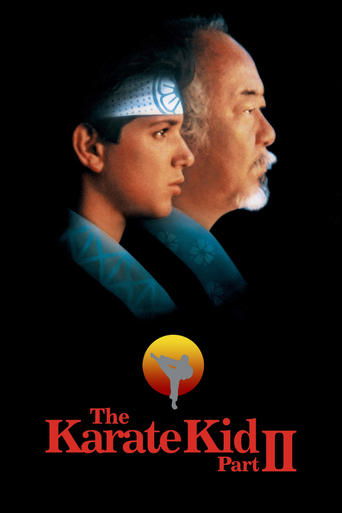
Cover of The Karate Kid Part II

film

The Karate Kid Part II

1986

Summoned by his dying father, Miyagi returns to his homeland of Okinawa, with Daniel, after a 40-year exile. There he must confront Yukie, the love of his youth, and Sato, his former best friend turned vengeful rival. Sato is bent on a fight to the death, even if it means the destruction of their village. Daniel finds his own love in Yukia's niece, Kumiko, and his own enemy in Sato's nephew, the vicious Chozen. Now, far away from the tournaments, cheering crowds and safety of home, Daniel will face his greatest challenge ever when the cost of honor is life itself.

Ages 12+Source checked

Why this age? The film contains martial arts combat, some intense sequences including a typhoon and a hostage situation, and themes of honor and revenge that may be more engaging and appropriate for pre-teens and older viewers. This is guidance, not a safety guarantee; reading level and family context may differ.

Quick view

At a glance

Recommended age12+

Strongest cautions

  • Violence4/5
  • Death of a character3/5
  • Frightening scenes3/5

Strongest positives

  • Courage & resilience4/5
  • Good role models4/5
  • Kindness & empathy4/5

What’s in it?

Products & advertising1/5
Why this rating?

No significant product placement or commercial tie-ins.

Death of a character3/5
Why this rating?

Miyagi's dying father dies, and several conflicts involve explicit threats to kill, though the major final fight avoids a death.

Graphic injury1/5
Why this rating?

Occasional minor injuries, cuts, and scrapes consistent with martial arts movies, but nothing graphic.

Strong language1/5
Why this rating?

Contains occasional mild language and name-calling typical of a PG-rated teen drama.

Religious themes1/5
Why this rating?

Cultural ceremonies and traditional Okinawan observances are portrayed, though not explicitly as formal organized religion.

Romance2/5
Why this rating?

Miyagi's past love and Daniel's developing romance with Kumiko are meaningful but secondary to the action and family drama.

Frightening scenes3/5
Why this rating?

Threats of death, attacks, a hostage situation, a collapsing house, and a dangerous typhoon create repeated tension, though the PG adventure tone limits intensity.

Sexual content & nudity1/5
Why this rating?

Includes mild, culturally contextualized romantic affection; no explicit content.

Alcohol or drugs1/5
Why this rating?

Minimal or no depiction of substance use in the core narrative.

Violence4/5
Why this rating?

Repeated martial-arts confrontations, attacks, property destruction, a hostage situation, and a fight framed as potentially lethal.

What’s good in it?

Courage & resilience4/5
Why this rating?

Daniel and Miyagi repeatedly face threats, rescue people during a typhoon, and confront violence without surrendering their principles.

Creativity & curiosity3/5
Why this rating?

The drum technique, inventive rescue situations, and problem-solving support imagination, discipline, and creative thinking.

Diverse representation3/5
Why this rating?

The story centers Japanese characters and Okinawan community life, with substantial cross-cultural relationships, though representation is relatively narrow.

Educational value2/5
Why this rating?

The film introduces karate principles, Japanese traditions, and some cultural and environmental context, though education is not its main purpose.

Kindness & empathy4/5
Why this rating?

Characters rescue one another, forgive past wrongs, rebuild the village, and protect vulnerable people despite conflict.

Positive messages4/5
Why this rating?

The story strongly endorses mercy, self-control, courage, forgiveness, community cooperation, and opposing exploitation and revenge.

Good role models4/5
Why this rating?

Miyagi models restraint and compassion; Daniel chooses mercy; Sato accepts responsibility, while Chozen models destructive vengeance.

Family discussion

Talk about it

Conversation starters based on this title’s published content notes.

  1. What did courage look like in this story? Was being brave always the same as being fearless?
  2. How did the story handle conflict or violence? Did the characters have other choices?
  3. Which choice in The Karate Kid Part II would you have made differently, and why?
  4. Who changed the most in The Karate Kid Part II, and what caused that change?
Discuss this title with other parents

Community reactions

What families noticed

Add your perspective

Sign in from the homepage to rate this title.

Where to watch or buy

As an Amazon Associate, Dickens & Rumi may earn from qualifying purchases, at no extra cost to you.

These content notes are a starting point, not a guarantee. Review the evidence and use your own judgment before choosing a title.

Report an incorrect rating