Dickens & Rumi
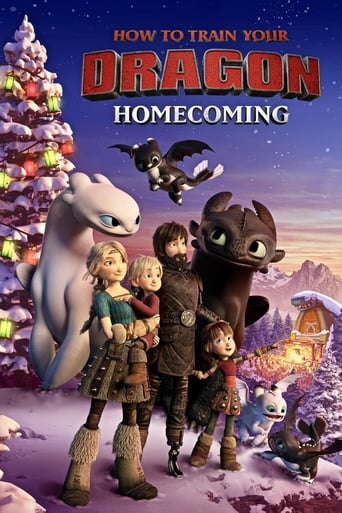
Cover of How to Train Your Dragon: Homecoming

film

How to Train Your Dragon: Homecoming

2019

It's been ten years since the dragons moved to the Hidden World, and even though Toothless doesn't live in New Berk anymore, Hiccup continues the holiday traditions he once shared with his best friend. But the Vikings of New Berk were beginning to forget about their friendship with dragons. Hiccup, Astrid, and Gobber know just what to do to keep the dragons in the villagers' hearts. And across the sea, the dragons have a plan of their own...

Ages 6+Source checked

Why this age? Mostly warm, family-oriented fantasy with mild suspense, a stage fire, a cliff fall and children briefly separated from their parents. The themes and story are accessible to young viewers with minor sensitivity to peril. This is guidance, not a safety guarantee; reading level and family context may differ.

Quick view

At a glance

Recommended age6+

Strongest cautions

  • Frightening scenes2/5
  • Death of a character1/5
  • Products & advertising1/5
Strongest positives

  • Good role models4/5
  • Kindness & empathy4/5
  • Positive messages4/5

What’s in it?

Products & advertising1/5
Why this rating?

Although part of a major franchise, the story material does not indicate product placement or purchasing pressure.

Death of a character1/5
Why this rating?

References are made to deceased ancestors (Stoick), which are treated with respect.

Romance1/5
Why this rating?

Features the established, loving relationship between Hiccup and Astrid.

Frightening scenes2/5
Why this rating?

A brief moment of panic when dragons go missing, but nothing intended to truly frighten.

Violence1/5
Why this rating?

Some mild slapstick comedy, a fire accident on stage, and brief, non-harmful chasing.

What’s good in it?

Courage & resilience3/5
Why this rating?

Characters face fear and social misunderstanding, and Toothless rescues Hiccup during the dangerous pageant accident.

Creativity & curiosity3/5
Why this rating?

A theatrical pageant, costumes, storytelling, mechanical dragon effects, and imaginative dragon behavior are central to the plot.

Diverse representation1/5
Why this rating?

Vikings and dragons are distinct, well-developed communities, but the available story evidence shows little human demographic or identity diversity.

Educational value1/5
Why this rating?

It offers incidental social learning about empathy, history, family traditions, and resolving fear of unfamiliar groups.

Kindness & empathy4/5
Why this rating?

Care, reconciliation, friendship, and mutual understanding drive the story, with characters helping children and preserving relationships.

Positive messages4/5
Why this rating?

Strong messages support friendship across differences, rejecting inherited prejudice, preserving family traditions, and learning through empathy.

Good role models4/5
Why this rating?

Hiccup, Astrid, and Gobber work to challenge prejudice and guide children toward understanding; dragons also model family care.

Family discussion

Talk about it

Conversation starters based on this title’s published content notes.

  1. Which character was the best role model, and what did they do that you admired?
  2. Which moment felt most tense or frightening? What helped the characters handle fear?
  3. Which choice in How to Train Your Dragon: Homecoming would you have made differently, and why?
  4. Who changed the most in How to Train Your Dragon: Homecoming, and what caused that change?
Discuss this title with other parents

Community reactions

What families noticed

Add your perspective

Sign in from the homepage to rate this title.

Where to watch or buy

As an Amazon Associate, Dickens & Rumi may earn from qualifying purchases, at no extra cost to you.

These content notes are a starting point, not a guarantee. Review the evidence and use your own judgment before choosing a title.

Report an incorrect rating