Dickens & Rumi
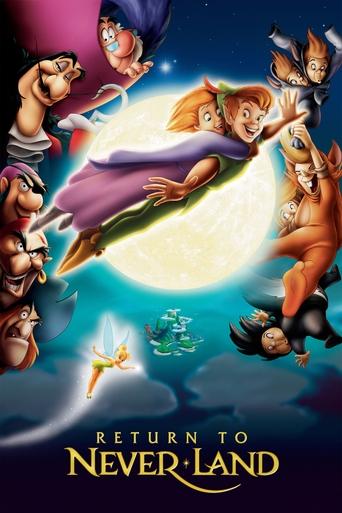
Cover of Return to Never Land

film

Return to Never Land

2002

In 1940, the world is besieged by World War II. Wendy, all grown up, has two children; including Jane, who does not believe Wendy's stories about Peter Pan.

Ages 7+Source checked

Why this age? Generally suitable for children, but abduction, wartime separation, threats of being fed to an octopus, pirate peril, and a frightening apparent death may trouble younger viewers. This is guidance, not a safety guarantee; reading level and family context may differ.

Quick view

At a glance

Recommended age7+

Strongest cautions

  • Frightening scenes3/5
  • Death of a character2/5
  • Violence2/5

Strongest positives

  • Creativity & curiosity4/5
  • Positive messages4/5
  • Courage & resilience3/5

What’s in it?

Products & advertising1/5
Why this rating?

Part of a massive Disney franchise; some commercial tie-ins typical of company output.

Death of a character2/5
Why this rating?

Tinker Bell appears lifeless and Jane believes she has died, but belief revives her; no lasting character death is described.

Strong language1/5
Why this rating?

Clean, appropriate language for a G-rated film.

Romance1/5
Why this rating?

No romantic subplots; focus is on family and friendship.

Frightening scenes3/5
Why this rating?

A child is abducted, held by pirates, threatened with an octopus, and endangered aboard a pirate ship; peril is fantastical but sustained.

Violence2/5
Why this rating?

Cartoon adventure includes pirate capture, fights, a sinking ship, threats, and chase scenes, without realistic injury detail.

What’s good in it?

Courage & resilience3/5
Why this rating?

Jane confronts fear, admits wrongdoing, rescues friends, learns to fly, and faces pirates to help Peter and the Lost Boys.

Creativity & curiosity4/5
Why this rating?

Flying, fairies, Neverland, imaginative games, treasure hunting, and inventive problem-solving strongly encourage fantasy and creative play.

Diverse representation1/5
Why this rating?

Limited in scope given the source material; mostly standard fantasy tropes.

Educational value1/5
Why this rating?

It offers limited social-emotional learning about grief, responsibility, family, and courage, but is primarily fantasy entertainment.

Kindness & empathy3/5
Why this rating?

Rescue, cooperation, family care, reconciliation, and concern for Tinker Bell are important, despite conflict and betrayal.

Positive messages4/5
Why this rating?

It supports belief, accountability, reconciliation, loyalty, family connection, and learning from selfish choices, while also valuing imagination.

Good role models3/5
Why this rating?

Jane learns empathy and responsibility; Peter Pan remains a playful, though sometimes reckless, guide.

Family discussion

Talk about it

Conversation starters based on this title’s published content notes.

  1. What was the most imaginative idea in the story, and what would you add to it?
  2. Which moment felt most tense or frightening? What helped the characters handle fear?
  3. Which choice in Return to Never Land would you have made differently, and why?
  4. Who changed the most in Return to Never Land, and what caused that change?
Discuss this title with other parents

Community reactions

What families noticed

Add your perspective

Sign in from the homepage to rate this title.

Where to watch or buy

As an Amazon Associate, Dickens & Rumi may earn from qualifying purchases, at no extra cost to you.

These content notes are a starting point, not a guarantee. Review the evidence and use your own judgment before choosing a title.

Report an incorrect rating