Dickens & Rumi
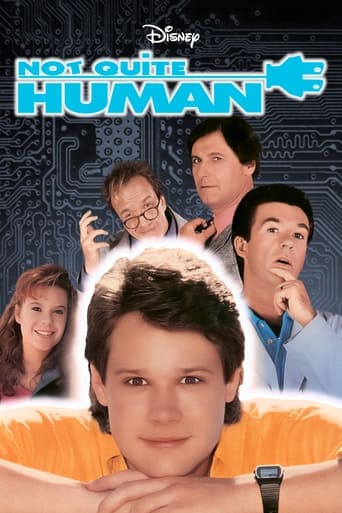
Cover of Not Quite Human

film

Not Quite Human

1987

Dr. Jonas Carson, a scientist, invents Chip, an android teenager. Dr. Carson sends Chip to school with his daughter Becky to see whether an android could interact with others. But his former employer decides to try and make a profit by stealing the mechanical boy.

Ages 8+Source checked

Why this age? Family-oriented comedy with kidnapping, pursuit, mechanical danger, attempted reprogramming, and a temporary apparent death, but little graphic detail and a reassuring resolution. This is guidance, not a safety guarantee; reading level and family context may differ.

Quick view

At a glance

Recommended age8+

Strongest cautions

  • Death of a character2/5
  • Frightening scenes2/5
  • Violence2/5

Strongest positives

  • Kindness & empathy4/5
  • Courage & resilience3/5
  • Creativity & curiosity3/5

What’s in it?

Products & advertising1/5
Why this rating?

Some potential for generic product placement of the era, but no overt consumerist pressure.

Death of a character2/5
Why this rating?

There is a momentary 'death' of the android character, which is quickly resolved, serving as a plot device rather than a somber reflection on mortality.

Strong language1/5
Why this rating?

The available information suggests only mild, age-appropriate language, with no indication of slurs or strong profanity.

Romance1/5
Why this rating?

Light, innocent teenage crush dynamics common in high school settings.

Frightening scenes2/5
Why this rating?

Brief moments of tension involving an antagonist and the threat of abduction, but overall light and non-frightening.

Violence2/5
Why this rating?

Features mild slapstick and a scene of attempted kidnapping and confinement. Threat of a car-crushing machine poses danger, but violence is not graphic.

What’s good in it?

Courage & resilience3/5
Why this rating?

Chip and his family display courage in defending themselves from exploitation.

Creativity & curiosity3/5
Why this rating?

Inventing an android, imagining artificial personhood, and solving problems through Chip’s unusual abilities strongly encourage imaginative thinking.

Diverse representation1/5
Why this rating?

Typical of 1980s family media; representation is fairly limited by modern standards.

Educational value1/5
Why this rating?

Incidental focus on science and robotics, though not deeply educational in a formal sense.

Kindness & empathy4/5
Why this rating?

Family members care for and defend Chip, while friendship and acceptance help him belong; villains treat him as property.

Positive messages3/5
Why this rating?

Emphasizes family acceptance, personhood, loyalty, resisting exploitation, and judging humanity by character rather than origins.

Good role models3/5
Why this rating?

The protagonist acts with sincerity and kindness, serving as a generally positive, albeit naive, role model.

Family discussion

Talk about it

Conversation starters based on this title’s published content notes.

  1. Where did a character show kindness or empathy, and what changed because of it?
  2. How did the story approach death or loss? What helped the characters cope?
  3. Which choice in Not Quite Human would you have made differently, and why?
  4. Who changed the most in Not Quite Human, and what caused that change?
Discuss this title with other parents

Community reactions

What families noticed

Add your perspective

Sign in from the homepage to rate this title.

Where to watch or buy

As an Amazon Associate, Dickens & Rumi may earn from qualifying purchases, at no extra cost to you.

These content notes are a starting point, not a guarantee. Review the evidence and use your own judgment before choosing a title.

Report an incorrect rating