Dickens & Rumi
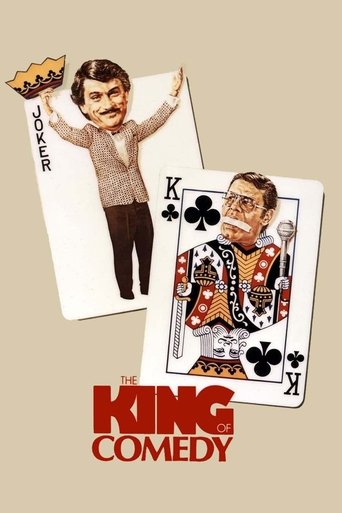
Cover of The King of Comedy

film

The King of Comedy

1983

Aspiring comic Rupert Pupkin attempts to achieve success in show business by stalking his idol, a late night talk-show host who craves his own privacy.

Source checked

Quick view

At a glance

Recommended ageNot listed

Strongest cautions

  • Frightening scenes3/5
  • Strong language3/5
  • Violence3/5

Strongest positives

  • Positive messages3/5
  • Creativity & curiosity2/5
  • Courage & resilience1/5

What’s in it?

Products & advertising1/5
Why this rating?

Television, celebrity culture, and commercial entertainment are central themes, but the film does not promote specific products or encourage buying.
Strong language3/5
Why this rating?

Occasional use of mild to moderate strong language.

Romance1/5
Why this rating?

Adult attraction and romantic fixation appear, but romance is not the film's main focus.

Frightening scenes3/5
Why this rating?

Psychological tension, stalking, abduction, and unpredictable behavior create an unsettling atmosphere.

Sexual content & nudity1/5
Why this rating?

Mild adult sexual references and suggestive relationship material appear, but there is no explicit sexual activity or nudity.

Alcohol or drugs2/5
Why this rating?

Alcohol and adult substance-related behavior appear, without being the central subject.

Violence3/5
Why this rating?

Includes a kidnapping involving a firearm and physical threats, though the violence is more psychological than graphic.

What’s good in it?

Courage & resilience1/5
Why this rating?

Persistence and ambition are present, but reckless entitlement is often mistaken for courage and is not a healthy model.

Creativity & curiosity2/5
Why this rating?

Performance, comedy, self-invention, and media spectacle are central, though creativity is frequently entangled with delusion and exploitation.

Diverse representation1/5
Why this rating?

Limited diversity typical of its era and production context.

Educational value1/5
Why this rating?

It offers insight into media, celebrity, ambition, and performance, but is not designed as instructional content.

Kindness & empathy1/5
Why this rating?

Empathy and care are limited; relationships are often transactional, exploitative, or distorted by obsession.

Positive messages3/5
Why this rating?

It examines entitlement, obsession, exploitation, and the dangers of confusing fame with personal worth; its satire is morally unsettling.

Good role models1/5
Why this rating?

Most major figures behave selfishly, manipulatively, or irresponsibly, offering cautionary rather than aspirational examples.

Family discussion

Talk about it

Conversation starters based on this title’s published content notes.

  1. What message do you think the story most wants you to remember?
  2. Which moment felt most tense or frightening? What helped the characters handle fear?
  3. Which choice in The King of Comedy would you have made differently, and why?
  4. Who changed the most in The King of Comedy, and what caused that change?
Discuss this title with other parents

Community reactions

What families noticed

Add your perspective

Sign in from the homepage to rate this title.

Where to watch or buy

As an Amazon Associate, Dickens & Rumi may earn from qualifying purchases, at no extra cost to you.

These content notes are a starting point, not a guarantee. Review the evidence and use your own judgment before choosing a title.

Report an incorrect rating