Dickens & Rumi
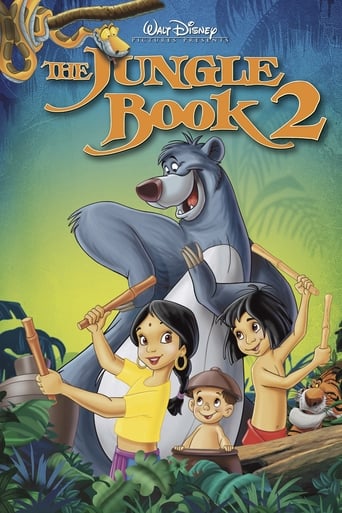
Cover of The Jungle Book 2

film

The Jungle Book 2

2003

Mowgli has been living in the man-village with his little stepbrother Ranjan and his best friend Shanti. But the man-cub still has that jungle rhythm in his heart, and he misses his old buddies Baloo and Bagheera. When Mowgli wanders back to the wild for some swingin' fun, he soon finds the man-eating tiger Shere Khan is lurking in the shadows and planning his revenge.

Ages 6+Source checked

Why this age? Younger children may find the stalking tiger, attempted eating, kidnappings or rescues, cliff danger, and lava climax intense. The peril is resolved safely and the film has a G-rated, comic adventure tone. This is guidance, not a safety guarantee; reading level and family context may differ.

Quick view

At a glance

Recommended age6+

Strongest cautions

  • Frightening scenes3/5
  • Violence3/5
  • Death of a character1/5

Strongest positives

  • Courage & resilience3/5
  • Kindness & empathy3/5
  • Positive messages3/5

What’s in it?

Products & advertising1/5
Why this rating?

Standard Disney merchandising tie-ins common for the release.

Death of a character1/5
Why this rating?

The villain Shere Khan is defeated and trapped, implied demise, but handled without graphic detail.

Strong language1/5
Why this rating?

Clean, age-appropriate language throughout.

Romance1/5
Why this rating?

Focus is on friendship between children and animals.

Frightening scenes3/5
Why this rating?

A man-eating tiger hunts children, a snake attempts to eat them, and characters face cliffs, a dark temple, and a lava pit.

Violence3/5
Why this rating?

Cartoon violence includes animal attacks, chasing, tackling, hitting, and characters being threatened by a tiger and snake; peril is frequent but not graphically presented.

What’s good in it?

Courage & resilience3/5
Why this rating?

Mowgli, Shanti, Ranjan, and Baloo face a dangerous predator and rescue situations, showing bravery and loyalty; some early choices are reckless.

Creativity & curiosity2/5
Why this rating?

The film encourages imaginative play through its musical jungle world, inventive animal characters, and problem-solving during the temple confrontation.

Diverse representation2/5
Why this rating?

Features a diverse setting (India), though characters are stylized animated archetypes.

Kindness & empathy3/5
Why this rating?

Friendship, rescue, family care, apology, reconciliation, and concern for others are recurring themes, although characters also tease and exclude one another.

Positive messages3/5
Why this rating?

The film emphasizes belonging, honesty, reconciliation, listening to children, balancing freedom with responsibility, and accepting multiple parts of one's identity.

Good role models2/5
Why this rating?

Mowgli makes unsafe and dishonest choices, but learns from them; Baloo ultimately prioritizes Mowgli's wellbeing, and the children show loyalty and courage.

Family discussion

Talk about it

Conversation starters based on this title’s published content notes.

  1. What did courage look like in this story? Was being brave always the same as being fearless?
  2. Which moment felt most tense or frightening? What helped the characters handle fear?
  3. Which choice in The Jungle Book 2 would you have made differently, and why?
  4. Who changed the most in The Jungle Book 2, and what caused that change?
Discuss this title with other parents

Community reactions

What families noticed

Add your perspective

Sign in from the homepage to rate this title.

Where to watch or buy

As an Amazon Associate, Dickens & Rumi may earn from qualifying purchases, at no extra cost to you.

These content notes are a starting point, not a guarantee. Review the evidence and use your own judgment before choosing a title.

Report an incorrect rating